
Basque sports.Character and identity

TIME
January 2025
In Bizkaia, the Basque Country and Navarre, traditional sports with strong local roots have been preserved, adapted and modernised. Today, they have a considerable following and, in some cases, can be considered mass sports.
Most of these sports, with the exception of pelota, are linked to work at sea, in the fields, quarries or mines. The challenges between workers and crews modulated the development of competitions until, well into the 20th century, sports federations appeared with their calendars and rules.
In all cases, whether they are championships or exhibitions, these sports offer a unique experience that is difficult to replicate in other regions, and are usually held in a festive environment and context. These sports speak not only of the character and identity of those who practise them, but also of their community. Make the most of the opportunity.
PELOTA
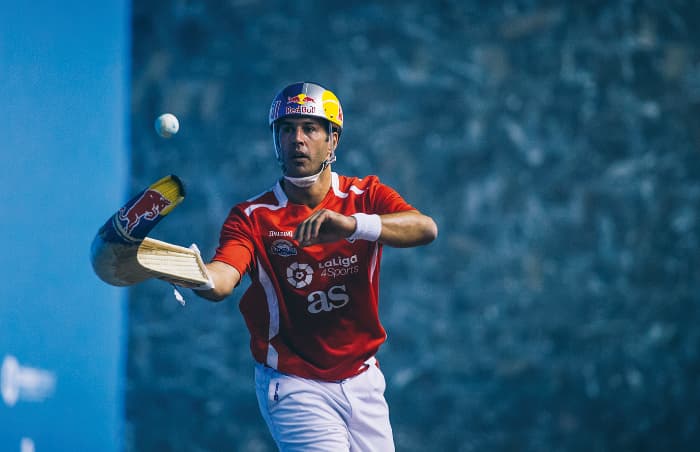
It is played in different types of frontons, both open and indoors, with a left wall or just a front wall, as well as in the complicated trinquetes attached to taverns and restaurants. The tools (zesta, xistera, pala, paleta, erremonte, xare, eskupilota) are as varied as the types of pelota themselves and the ways in which they are played: individually, in pairs, the whole fronton, on the 4’5”, and so on. There is no doubt that you will be able to attend a match very close to where you are. They are available every weekend and all over the country.
The most international and glamorous modality is cesta. It is played all over the world. There have been frontons in Cairo, Shanghai, Tijuana, Milan, Macau and Miami, to name but a few. Fast, very difficult to play and always spectacular, Gernika Jaia Alai is hosting the games of the Eusko Label Winter Series until the 16th of February.

AIZKOLARITZA
These are competitions in which men or women use axes to cut beech logs of a certain radius. The competition can be based on time or number of cuts.
HARRIJASOTZE
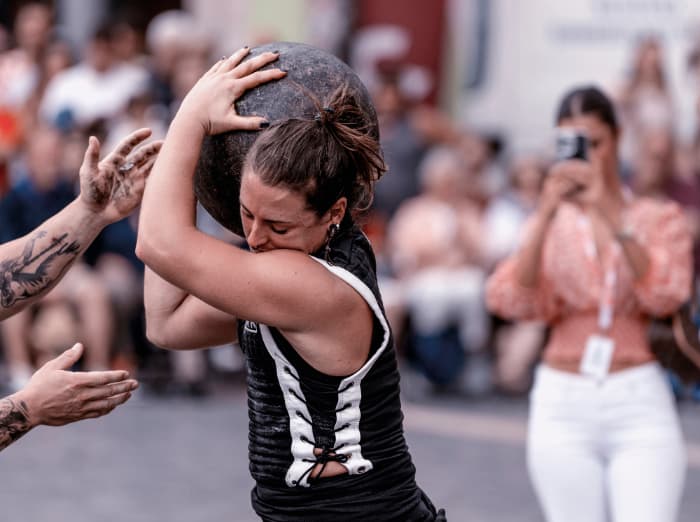
Athletes who lift stones from the ground until they are balanced on one shoulder. It is a highly technical sport using cubic, spherical or cylindrical stones. Sometimes the stones are famous, found in a particular place and used for this purpose since time immemorial. The competition can take place as a result of championships organised by the federation or as a challenge between stonelifters. There are judges, a time limit and a strict count of the lifts. Stones can weigh as little as 75 kg (165 pounds) or as much as 300 kg (660 pounds). The range in between is almost infinite.
There is also the modality of the stone drag. It is carried out on a cobbled surface called a ‘carrejo’ and is measured in ‘clavos’ (about 27 yards), usually with large stones. It can be pulled by
a man or woman, a group of men or women, or work animals such as mules, horses or oxen.
Other sports include soka-tira, in which two teams of balanced weights pull on both ends of a rope. Tronza, in which pairs compete to be first to saw a log by hand. Barrena, which consists of drilling a hole in a rock with a steel instrument. In addition, there are other less widespread local sports. All of them are spectacular.
Fixed seat boat races
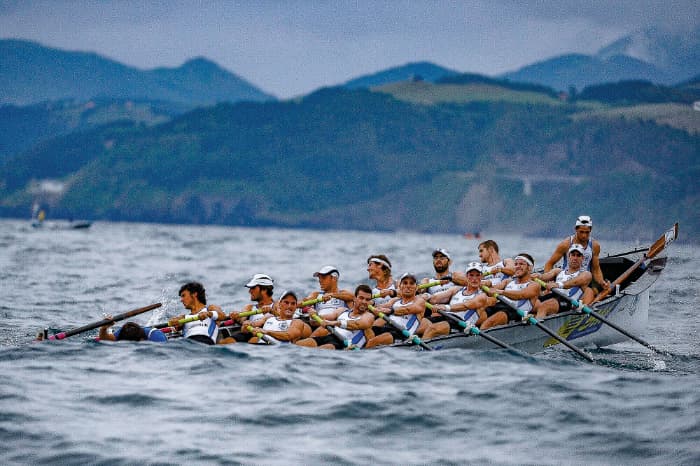
From spring to autumn, fixed seat boats compete in estuaries and bays. The trainera used to be a traditional boat that could carry crews of up to 16 rowers. Its origin dates back to the first half of the 18th century on the Basque coast. Originally, it could hold a pole with a lateen or gaff sail. But the oar was vital due to its functional purpose. It was used to catch sardines close to land with purse seine nets called “trainas”. It was the boat itself that surrounded the shoal of precious fish at the highest possible speed. The other function consisted of towing; that is to say, to tow ships that had to enter docks located inside narrow-mouthed estuaries that did bear any other system.
Nowadays, trawlers and oars are made of synthetic fibres. They are only used for racing. They must weigh at least 200 kilos, be 12 metres long, have a beam of about 1.75 metres and a depth of about 0.90 metres. The rowers sit on six two-seater benches, while the skipper rows standing up with the rudder in his hands and calls out the rhythm, and the proel rows on a single bench and participates in the manoeuvre called ziaboga, which consists of turning the course 180 degrees. The batels are smaller boats with a smaller crew.
In winter and summer, you can watch trawlers and rowing boats training in the Bilbao estuary at sunset. They pass the Guggenheim.
Photo: © Pedro Luis Ajuriaguerra

MARINELA
RESTAURANT
Basque cuisine with a touch of innovation.
Open Cooking 13:00 a 23:00 h. NON STOP

GOGOA
BAR-RESTAURANT
Enjoy the best Vermouth.
SET MENU & BURGERS
You may be interested…

2026 Carnival in Bilbao y Bizkaia
From 12 to 17 January

From Holy Week to Basque Fest 2026
Passion and Tradition

Bilbao Fashion Week 2025
The great Showcase